Sample Face Report — Measurements, Styling Notes & Action Plan
Explore the score explanation, hairstyle tradeoffs, salon brief and practical action plan before choosing a private FaceRater report.
Last updated: 2026-09-24
A report should help you decide what to try next. This walkthrough uses invented example readings, clearly separated from photo demonstrations. It is not a testimonial or a ranking of anyone's appearance.
How to read this public sample
Your private report connects your photo reading to your styling choices.
A real report uses your own measurements and stated preferences from start to finish. This public walkthrough keeps two demonstrations separate: invented measurements show the explanation format, while a licensed stock portrait shows the seven-image styling experience.
- 1. UnderstandSee what the photo supports and what it cannot show.
- 2. CompareReview one overall concept and six hairstyle directions.
- 3. ActSave a salon brief and a low-risk next-step plan.
01 — Example interpretation
Invented readings for this walkthrough. They do not describe the person in the styling images.
Example: compare how hair frames an outline.
These invented readings describe more height than width (width/height 0.780). Compare hair beside the cheeks with a more exposed outline. You are choosing where the frame draws attention, not correcting your proportions.
Visible outline
The detected outline is taller than it is wide. Width / visible height: 0.780.
What to compare: Look at where the hair ends or bends beside your cheeks and jaw. Which outline do you prefer?
Left and right
Average paired-point difference: 1.80% of visible face width. The largest detected difference is at outer eye corners.
What to compare: Recheck the outer eye corners with a relaxed expression. A different expression can change the observed left/right difference.
Eye-area spacing
The gap between the inner eye corners is 26.0% of visible face width.
What to compare: Compare front pieces away from the eyes with hair closer to the brows. Notice visibility and comfort, rather than trying to reach a target gap.
Two starting points: Textured lob or Pulled-back variation
Chosen from example preferences. Use the photo observations above to judge the difference; a measurement cannot pick a haircut for you.
Compare the two looksExplore the example score and diagrams
Illustrative geometry example
89 / 100
These invented readings demonstrate how the report works. They do not describe any person pictured elsewhere on this page. Scores are calculated by the same code as the free tool.
Compare personal styling choices
These seven AI-generated images come from one completed product demonstration using a licensed stock portrait. The person is not a customer testimonial; the separate geometry example is invented and unrelated to her.
These are direction references, not a virtual try-on. Judge the hair shape and coverage only: AI can still change expression, hair shade, facial detail or framing. Your private report uses a stricter identity-preservation instruction, but generated images remain simulations.
02 — Photo study
Seven AI styling examples
One concept · six hairstyle directions
Choose a direction to compare
Select a style to see its image, tradeoffs and salon brief together. Use these as hairstyle direction references, not an exact virtual try-on: facial detail, hair shade, expression and framing can drift. Upkeep estimates are general, not measured from your face.
Compare hair shape and coverage only. This is a direction reference, not an exact virtual try-on; facial detail, expression, shade and framing can drift.
YOUR SELECTION
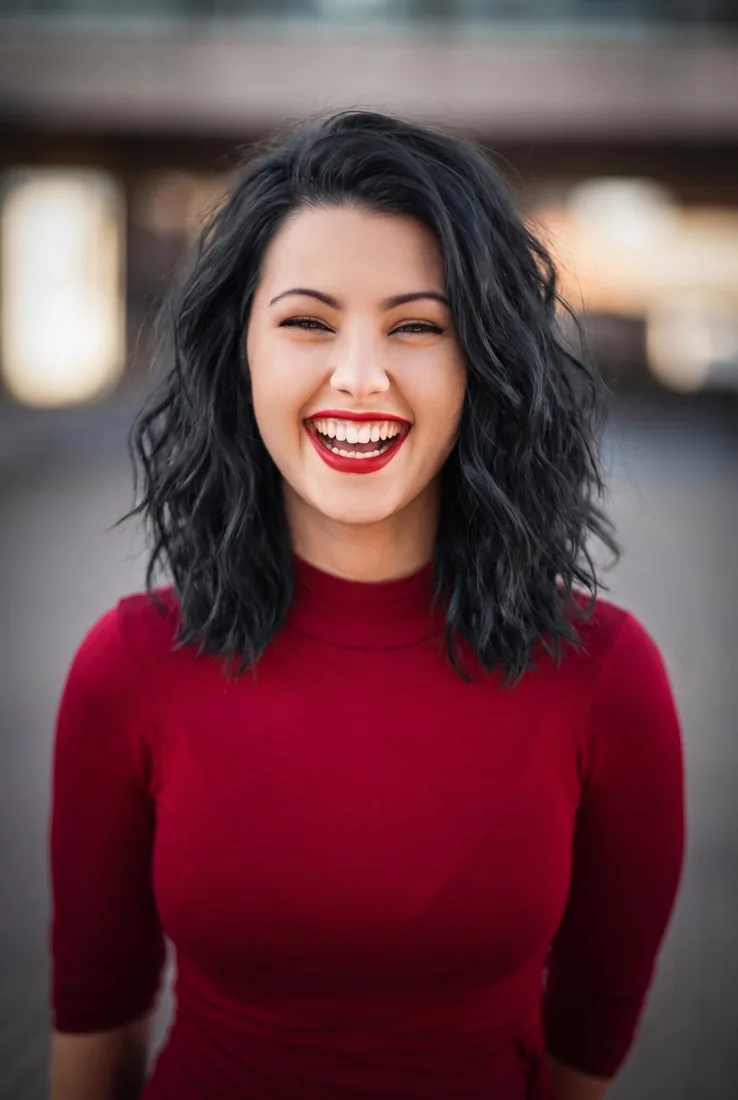
Look at the ends near the shoulders and the hair beside the cheeks. Does that longer frame feel preferable?
Upkeep: Allow roughly 5–15 minutes for light styling; discuss a trim around 8–12 weeks.
ALTERNATIVE
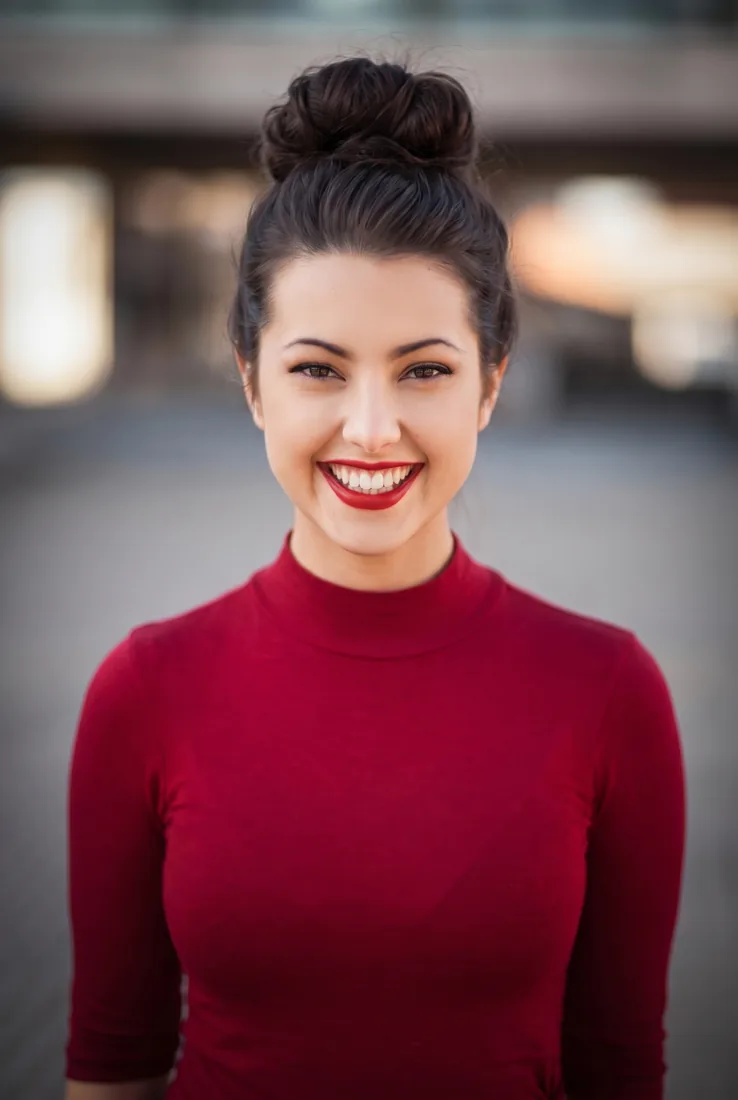
Look at the exposed cheek and jaw outline. Compare it with hair down before deciding whether you prefer that openness.
Upkeep: Usually 2–5 minutes if your current length reaches; no haircut required.
Textured lob
Look at the ends near the shoulders and the hair beside the cheeks. Does that longer frame feel preferable?
Upkeep: Allow roughly 5–15 minutes for light styling; discuss a trim around 8–12 weeks.
Pulled-back variation
Look at the exposed cheek and jaw outline. Compare it with hair down before deciding whether you prefer that openness.
Upkeep: Usually 2–5 minutes if your current length reaches; no haircut required.
Why these starting points?
Textured lob: Start here. Your stated length preference is shoulder-length. Start here if you want to keep useful length while changing the outline. Compare the change in outline before committing to a haircut. Your styling-time preference is 5–15 min; confirm the actual routine. Check how your waves fall air-dried, without copying the generated texture.
Pulled-back variation: Compare this alternative. Your stated length preference is shoulder-length. A pulled-back experiment can be tried without cutting if your current hair reaches. Compare the change in outline before committing to a haircut. Your styling-time preference is 5–15 min; confirm the actual routine. Check how your waves fall air-dried, without copying the generated texture.
Textured lob
Start here if you want to keep useful length while changing the outline.
Allow roughly 5–15 minutes for light styling; discuss a trim around 8–12 weeks.
Shoulder contact can flip the ends; natural waves may shorten the dry result.
Discuss a collarbone-length lob with light texture and a flexible part. Keep enough length for tying back if possible; check the dry fall with my natural texture.
The example preferences
Example preferences: shoulder-length, wavy hair, 5–15 minutes of styling, considering a new hairstyle. The shortlist uses these stated preferences, not the fictional score or a judgment of the pictured person.
Select a direction above, compare its upkeep and tradeoff, then save the one-page style card. It includes that exact image and the matching salon brief.
The first 72 hours
- Day 1: save one preferred outline and one concern.
- Day 2: try one reversible change with what you already own.
- Day 3: compare under the same light and camera distance. Keep what feels practical.
Over four weeks: repeat the style on ordinary days, confirm the brief with a stylist if desired, note effort and comfort, then keep, simplify or stop. No purchase is required.
Transparent score explanation
Overall = 0.4 × symmetry + 0.35 × proportions + 0.25 × eye harmony. The weighted calculation uses unrounded components; displayed scores are rounded.
symmetry: 78/100
Mean mirrored-pair deviation is 1.80% of visible face width. The largest difference is at outer eye corners (2.40%). Expression and camera angle can move these readings.
100 × clamp(1 − meanMirrorDeviationPct / 8, 0, 1). Deviation here is in percentage points, not a fraction.
Zero deviation maps to 100; 8% deviation maps to 0. This is a site-defined scale, not a population norm.
proportions: 100/100
Visible width/height is 0.780; upper/middle is 0.410 and lower/middle is 0.920. These describe the detected mesh in this photo, not an ideal face shape.
0.6 × bandScore(width/height) + 0.2 × bandScore(upper/middle) + 0.2 × bandScore(lower/middle). bandScore = 100 × clamp(1 − distance outside band / tolerance, 0, 1).
Initial bands: width/height 0.7–0.9 (tolerance 0.3); upper/middle 0.3–0.6 (0.35); lower/middle 0.7–1.05 (0.4). Landmark forehead top is not the hairline.
eyeHarmony: 92/100
Inner-canthal distance / face width is 0.260; eye-width asymmetry is 2.40%. Glasses, a head turn or squinting can affect the result.
0.6 × bandScore(inner-canthal/face width) + 0.4 × 100 × clamp(1 − eyeWidthAsymmetryPct / 12, 0, 1). bandScore uses distance outside the band divided by 0.12.
Initial inner-canthal/face-width band 0.22–0.3; tolerance 0.12. Eye-width asymmetry of 12% maps its component to 0.
What the paid report includes
An expanded appendix of 35 supported photo readings (overlapping the ten free readouts, not 35 additional or independent beauty scores), an overall styling concept and six private hairstyle simulations, matching upkeep notes and salon briefs, a 72-hour and four-week plan, and a downloadable PDF with the same images and advice. If you re-select the matching original, local comparison diagrams can also be added to your PDF without uploading it again.
AI images can change framing, hair shade or expression. Use them to discuss a hairstyle, not to infer a change to your face. Initial reference bands are uncalibrated site-defined heuristics. There is no attractiveness percentile, diagnosis, or predicted transformation.
Try the free face rater · Read the methodology · See the $6.99 report